How I Run Honcho for Long-Term Agent Memory
How I Run Honcho for Long-Term Agent Memory

I self-host Honcho as the shared memory backend for my agents. Honcho stores what happened, derives useful conclusions, models the participants, and returns relevant context.
This article follows the process from message ingestion to memory recall, including conclusions, directional representation of peers and dreaming.
Honcho storage
Agents write messages to Honcho inside a workspace. Honcho turns those messages into several forms of memory:
- Messages (conversation history).
- Embeddings support semantic retrieval.
- Conclusions capture facts and patterns derived from conversations.
- Session summaries
- Peer representations model what one participant knows or believes about another.
- Dialectic recall builds context for the current conversation from stored memory.
Architecture
flowchart TD
    agent["Agent runtime"]
    adapter["Memory adapter"]
    api["Honcho API"]
    postgres[("PostgreSQL + pgvector")]
    redis[("Redis")]
    workers["Deriver and dreaming workers"]
    models["Language and embedding models"]

    agent -->|"Messages and context requests"| adapter
    adapter -->|"Honcho API calls"| api
    api --> postgres
    api --> redis
    redis --> workers
    workers --> postgres
    workers --> models
Components
- The agent runtime delegates memory operations to an adapter.
- The Honcho API receives messages, persists records, queues derivation work, and serves recall requests.
- PostgreSQL with pgvector stores records and their embeddings.
- Redis coordinates caching and queued derivation work.
- The deriver turns new messages into conclusions and representations.
- Dreaming workers revisit accumulated conclusions and consolidate them.
How memory is stored
The flow is:
flowchart LR
    write["Write messages"] --> background["Deriver and dreamer<br/>build memory in the background"]
    background --> serve["Adapter prepares base context<br/>every turn and dialectic<br/>synthesis every ~2 turns"]
    serve --> trivial{"Non-trivial turn?"}
    trivial -->|No| skip["Skip automatic injection"]
    trivial -->|Yes| inject["Inject recalled context"]
    inject --> depth["Scale dialectic depth<br/>by query length"]
After an agent completes a response, it’s memory adapter sends the original user prompt and final response to Honcho on a background worker.
Those saved interactions enter Honcho’s background pipeline. The deriver processes them into conclusions and representations. It groups representations in batches of around a 512-tokens, so short messages can sit in a small pending batch until enough content accumulates. Dreaming handles slower consolidation. A cycle becomes eligible after 50 new explicit conclusions, with an eight-hour cooldown and a 60-minute idle period. It can reconcile existing conclusions, derive new ones, and update stable representations.
The same worker that wrote the exchange also starts recall for later turns.
Honcho exposes two complementary recall paths, and the adapter schedules them differently:
- Base context is the structured pack from Honcho’s context path:
- session summary,
- peer cards, and
- representations.
- It refreshes every turn so the next request sees updates from the latest write.
- Dialectic synthesis is Honcho’s natural-language answer to a question about the user:
- The adapter asks that question through
peer.chat(). - Honcho searches stored conclusions and related memory, then writes the answer.
- The adapter appends that answer to the recalled context as the dialectic supplement.
- The adapter requests a new synthesis at session start, then every two turns.
- The adapter asks that question through
Preparation is ahead of consumption. The worker prepares the result in the background; the next non-trivial turn consumes the cached pack instead of blocking on a full recall first.
A dialectic pass starts at low reasoning effort. This setting can increase if the user message is long enough to justify deeper synthesis.
Peers and directional representations
Honcho organizes memory in workspaces that isolate their records. Peers are created independently inside a workspace, so a workspace can contain zero, one, or many peers. For a human-agent memory system, a sensible default is to have two peers:
Humanrepresents the user.AIrepresents the agent.
Each observer-observed pairing maintains a directional representation, or mental model:
flowchart LR
    subgraph workspace["Honcho workspace"]
        direction LR

        subgraph owners["Model owner"]
            direction TB
            humanOwner["Human"]
            aiOwner["AI"]
        end

        subgraph models["Directional representation"]
            direction TB
            humanOfHuman["Human's model of itself"]
            humanOfAi["Human's model of AI"]
            aiOfHuman["AI's model of Human"]
            aiOfAi["AI's model of itself"]
        end

        subgraph subjects["Modeled peer"]
            direction TB
            humanSubject["Human"]
            aiSubject["AI"]
        end

        humanOwner --> humanOfHuman --> humanSubject
        humanOwner --> humanOfAi --> aiSubject
        aiOwner --> aiOfHuman --> humanSubject
        aiOwner --> aiOfAi --> aiSubject
    end
Each relationship can have a peer card and a larger body of conclusions. A peer card contains a small set of stable identity facts. Conclusions contain observations and deductions that can evolve.
Connecting an agent to Honcho
An agent integration connects its runtime to Honcho through a memory adapter. The adapter writes completed exchanges, requests relevant context, and converts Honcho’s response into the runtime’s model-input format.
I use two context paths: automatic recalled memory and explicit memory tools. For instance Hemes at startup, reads memory.provider: honcho, loads the Honcho adapter, resolves the session, and registers Honcho tools. Honcho announces itself adding a capability notice to the cached system prompt.
The adapter then starts a background prewarm for the selected Honcho session. The prewarm requests base context and a dialectic synthesis so the first useful turn can begin with memory available.
For each non-trivial user turn, the following sequence runs:
sequenceDiagram
    participant R as Agent runtime
    participant M as Memory manager
    participant A as Honcho adapter
    participant O as Honcho
    participant L as Main model

    R->>M: Pass original user message
    M->>A: Request recalled context
    A->>A: Consume prepared base context
    Note right of A: Session summary<br/>User representation<br/>User peer card<br/>AI self-representation<br/>AI identity card
    A-->>O: Start semantic refresh using the user message
    O-->>A: Return context to cache for a later turn
    opt Prepared dialectic supplement is ready
        O-->>A: Return peer.chat() result based on the user model
    end
    A->>A: Join context and enforce the 1,200-token budget
    A-->>M: Return recalled context
    M->>M: Wrap it in a memory-context block with a system note
    M-->>R: Return recalled-memory block
    R->>R: Append block to an API-only copy of the user message
    R->>L: Send stable system prompt, history, and enriched user message
This sequence shows the prewarmed recall path in the adapter. Other agent runtimes can implement the same write-and-recall contract with their own timing, token budget, and session strategy.
The shape of the API-only user message is approximately:
<the user's current message>

<memory-context>
[System note identifying this as recalled reference data]

## Session Summary
...

## User Representation
...

## User Peer Card
...

## AI Self-Representation
...

## AI Identity Card
...

<dialectic supplement>
</memory-context>
The injected block exists only in the model request. The recalled context remains available for each model call in the tool loop.
My adapter skips automatic injection for acknowledgements and slash commands. An unavailable Honcho service produces an empty recall result while the agent continues the conversation.
The Hermes adapter’s hybrid mode also exposes honcho_profile, honcho_search, honcho_context, honcho_reasoning, and honcho_conclude. Their results enter the conversation as normal tool responses and complement the automatic context block.
Using Honcho through MCP
Honcho also ships an MCP server that exposes workspaces, peers, sessions, messages, conclusions, search, and dialectic chat as typed tools. I run the MCP gateway beside my self-hosted API and point its backend at the API’s loopback address. Claude Code, Codex, Cursor, Kiro, and other MCP clients can then use the same Honcho workspace.
Each client connection supplies an authorization token plus headers for the user peer, agent peer, and workspace. This preserves one user identity while giving each agent its own representation:
Authorization: bearer token for the MCP endpoint.X-Honcho-User-Name: the human peer.X-Honcho-Assistant-Name: the agent peer, such asclaude-codeorcodex.X-Honcho-Workspace-ID: the shared workspace, such ashermes.
Claude Code can connect directly to a Streamable HTTP endpoint:
claude mcp add honcho \
  --transport http \
  --url "https://mcp.example.com" \
  --header "Authorization: Bearer ${HONCHO_MCP_TOKEN}" \
  --header "X-Honcho-User-Name: Alfons" \
  --header "X-Honcho-Assistant-Name: claude-code" \
  --header "X-Honcho-Workspace-ID: hermes"
Codex can use mcp-remote as a local STDIO bridge so the connection includes the Honcho headers. The corresponding user-level ~/.codex/config.toml entry is:
[mcp_servers.honcho]
command = "npx"
args = [
  "-y",
  "mcp-remote",
  "https://mcp.example.com",
  "--header",
  "Authorization:${AUTH_HEADER}",
  "--header",
  "X-Honcho-User-Name:${USER_NAME}",
  "--header",
  "X-Honcho-Assistant-Name:codex",
  "--header",
  "X-Honcho-Workspace-ID:workspace"
]

[mcp_servers.honcho.env]
AUTH_HEADER = "Bearer <token>"
USER_NAME = "Username"
The MCP tools provide explicit memory operations. Client instructions can orchestrate the standard flow of creating a session, adding completed exchanges, and querying Honcho for context or a synthesized answer. A runtime adapter such as my Hermes integration adds automatic per-turn recall and background writes around that tool surface.
I keep bearer tokens in user-level configuration with restrictive file permissions. An endpoint reachable beyond a trusted private network should use HTTPS.
Browsing memory with OpenConcho
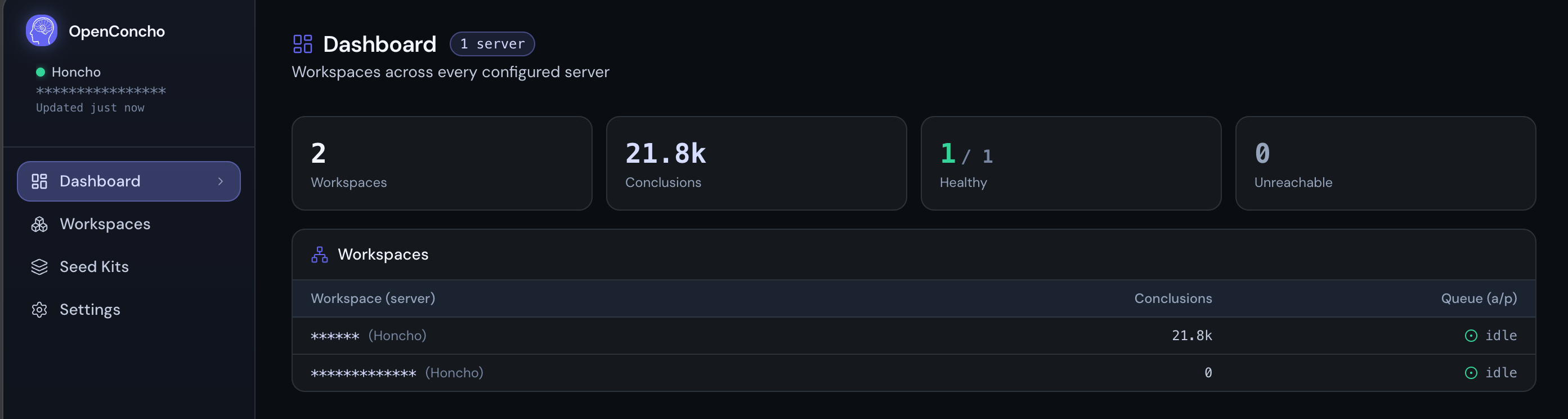
OpenConcho gives this stack a web UI. It runs as one more rootless Podman container beside the Honcho API, and its built-in proxy forwards requests only to the allow-listed Honcho address. From a workspace overview I can browse peers with their cards and directional representations, read session histories with summaries, search conclusions semantically, watch the derivation queue and dream runs live, manage webhooks, apply reusable peer-card seed kits, chat with full memory context through the dialectic endpoint, and trigger a dream consolidation pass on demand.
Conclusion
Honcho makes long-term memory a service shared by agent runtimes. An agent writes completed exchanges through its memory adapter, the Honcho API persists them and queues derivation work, background workers build conclusions and representations, and the adapter retrieves relevant context for a later model request.
Workspaces provide isolation, peers define the participants, directional representations preserve perspective, and sessions establish retrieval boundaries. Hermes is one client of this memory service. The same integration boundary lets additional agents use Honcho without duplicating the storage, derivation, and recall system.